| Skip ahead: | |
| Summary | Design |
| Value | Interior |
| Fuel Efficiency | Infotainment |
| Ownership Costs | Drive Comfort |
| Safety | Verdict |
2026 Suzuki eVitara Ultra
It has taken a fair while for Suzuki to enter the electric car game, but its first effort, the eVitara, is finally here.
But it could be too late.
While the Japanese car maker has been finessing its first EV, dozens and dozens of other brands – both new and established – have brought their own to market.
The game has changed.
Over the roughly five years that Suzuki has been developing the eVitara, so much has shifted in the electric vehicle space that it’s no longer enough for a brand to just have an EV; it needs to offer something special or different to set itself apart.
And unfortunately, Suzuki has made one really key mistake with this car that means it’s unlikely to be a sales success, even though it’s actually quite a nice little EV.
| Key details | 2026 Suzuki eVitara Ultra AWD |
| Price | $58,990 drive-away |
| Colour of test car | Land Breeze Green Pearl Metallic / Bluish Black Pearl Metallic |
| Options | Premium paint – $1345 |
| Price as tested | $60,335 |
| Drive-away price | $60,335 (VIC) |
| Rivals | BYD Atto 2 | Kia EV3 | MG S5 |


Is the Suzuki eVitara good value?
The big mistake is… the price.
The Suzuki eVitara comes in three flavours, starting with the front-wheel-drive Motion for $49,990 drive-away, wedged in the middle is an Ultra FWD for $54,990 drive-away, with the Ultra AWD sitting at the top for $58,990 drive-away.
It’s worth noting that the Ultra FWD is only available in Queensland and northern parts of New South Wales where Suzuki vehicles are distributed separately to the rest of the country.
I had the Ultra AWD on test, and it’s nice, but not $60K nice. To be competitive with similarly sized rivals, it needs to be about $20K cheaper than that.
Compared to a previous-generation petrol-powered Vitara, it’s a big step up with a lot more creature comforts, but there’s nothing you wouldn’t expect to get on a new car these days.
As standard, the Motion features a 10.1-inch infotainment screen and a 10.25-inch digital instrument cluster with wireless Apple CarPlay and Android Auto, 18-inch alloy wheels, ambient lighting, and a 360-degree camera.
The Ultra upgrades from fabric to synthetic leather upholstery, from a four-speaker sound system to an eight-speaker Infinity system with a subwoofer, and adds a power-adjusted driver’s seat, heated front seats, and a wireless charger.
Suzuki used to be a budget brand, but pricing its first EV so high just takes it out of contention for many.
You’d be mad to spend so much on this when you can get much bigger, better equipped and even more premium vehicles for the same amount, or conversely, similar-spec cars for less.
For example, the top-spec versions of the BYD Atto 2 and MG S5, the Premium and Essence 62, cost $35,990 and $47,990, respectively, before on-road costs.
The base version of the Kia EV3, the Air Standard Range, costs $47,600 before on-road costs.
But for the same sort of money, $58,900 plus ORCs to be exact, you can get a Tesla Model Y Premium Rear-Wheel Drive.
How much range does the Suzuki eVitara have?
A healthy driving range is also not a strength of the eVitara, despite its relatively large 61kWh battery.
The WLTP-claimed range is 395km, which might not sound that bad at first, but a number starting with a four is more competitive these days, and it’s not long before you start churning through it. The Motion has even less with just 344km available.
Average energy consumption is rated at 16.6 kilowatt-hours per 100 kilometres, but I could not achieve any less than 20kWh/100km no matter how hard I tried.
Turning off the heating even when it was freezing? Nothing. Driving around in Eco mode almost exclusively? Nada. Empty boot and driving solo? No dice.
At its highest, I saw consumption climb up to 30kWh/100km.
I used my Ohme 7kW home charger to top up regularly before the battery got too low, but I did have to plug in about four times over the week as the charge percentage fell rapidly each time I used it.
The Atto 2 Premium offers a claimed 345km, which is equally as problematic, but the Kia EV3 Air provides 436km of WLTP range. Stepping up to Air Long Range extends that to 604km, still for less money than the Suzuki.
The S5 Essence 62 claims a WLTP range of 450km.
The Suzuki eVitara can also only charge at a maximum rate of 70kW DC, whereas its rivals can all charge faster. The Atto 2’s maximum rate is 82kW, the EV3’s 100kW, and the S5’s 150kW.
| Fuel efficiency | 2026 Suzuki eVitara Ultra AWD |
| Energy cons. (claimed) | 16.6kWh/100km |
| Energy cons. (on test) | 20.0kWh/100km |
| Battery size | 61.0kWh |
| Driving range claim (WLTP) | 395km |
| Charge time (7kW) | 9h |
| Charge time (11kW) | 5h 30min |
| Charge time (70kW max rate) | 45min (claimed 10–80%) |
How much does the Suzuki eVitara cost to own?
Suzuki backs the eVitara with its usual five-year/unlimited-kilometre warranty, with an additional eight years/160,000km coverage for the battery, and five years of free roadside assistance.
Servicing is every 12 months or 20,000km, whichever comes first. But it’s not as cheap as you’d think.
As I know from personal experience as a Vitara owner, just because Suzuki is a budget brand does not mean its servicing costs will be the most affordable.
Three years for the eVitara will set you back $1177, or for five years it will cost $2515.
The BYD Atto 2, in comparison, costs just $739 for three years and $1414 for five with identical intervals; the Kia EV3 costs $688 or $1308 (with servicing every 12 months/15,000km); and the MG S5 costs $1119 or $1967 (with intervals of 12 months/25,000km).
BYD also backs the Atto 2 with a six-year/150,000km warranty and offers one year of free roadside assistance, while Kia and MG cover the EV3 and S5 for seven years or unlimited kilometres, with one year and two years of free roadside assistance, respectively.
The Suzuki eVitara Ultra AWD could cost $1925.08 to comprehensively insure based on a comparative quote for a 35-year-old male living in Chatswood, NSW. Insurance estimates may vary based on your location, driving history, and personal circumstances.
| At a glance | 2026 Suzuki eVitara Ultra AWD |
| Warranty | Five years, unlimited km |
| Battery warranty | Eight years, 160,000km |
| Service intervals | 12 months or 20,000km |
| Servicing costs | $1177 (3 years) $2515 (5 years) |
How safe is the Suzuki eVitara?
The Suzuki eVitara has a four-star ANCAP rating from 2025, missing out on the full five stars because it lacks a centre airbag.
In addition, the eVitara doesn’t come with a driver attention/fatigue monitor.
Depending on your view, this may be a good thing because it means the Vitara isn’t plagued by the constant chiming that new cars often have.
Overall, its assistance systems aren’t annoying at all. The lane-departure warning is quiet, as is the speed limit recognition ding.
The lane-keep assist is a bit too gentle, though; it’s almost non-existent, with only the softest of tugs and vibrations of the wheel to pull you back into line, and equally, the adaptive cruise control is quite sluggish to react to traffic.
The Kia EV3 and MG S5 both have five-star ratings from 2025, while the BYD Atto 2 hasn’t been tested because BYD has prioritised its Sealion 8 plug-in hybrid family SUV for testing instead.
| 2026 Suzuki eVitara | |
| ANCAP rating | Four stars (tested 2025) |
| Safety report | Link to ANCAP report |
| At a glance | 2026 Suzuki eVitara Ultra AWD | |
| Autonomous Emergency Braking (AEB) | Yes | Includes pedestrians, cyclist, and vehicle detection |
| Adaptive Cruise Control | Yes | Includes speed-limit changes |
| Blind Spot Alert | Yes | Alert only |
| Rear Cross-Traffic Alert | Yes | Alert only |
| Lane Assistance | Yes | Lane-departure warning, lane-keep assist |
| Road Sign Recognition | Yes | Includes speed-limit assist |
| Driver Attention Warning | No | |
| Cameras & Sensors | Yes | Front and rear sensors, 360-degree camera |
What is the Suzuki eVitara like on the outside?
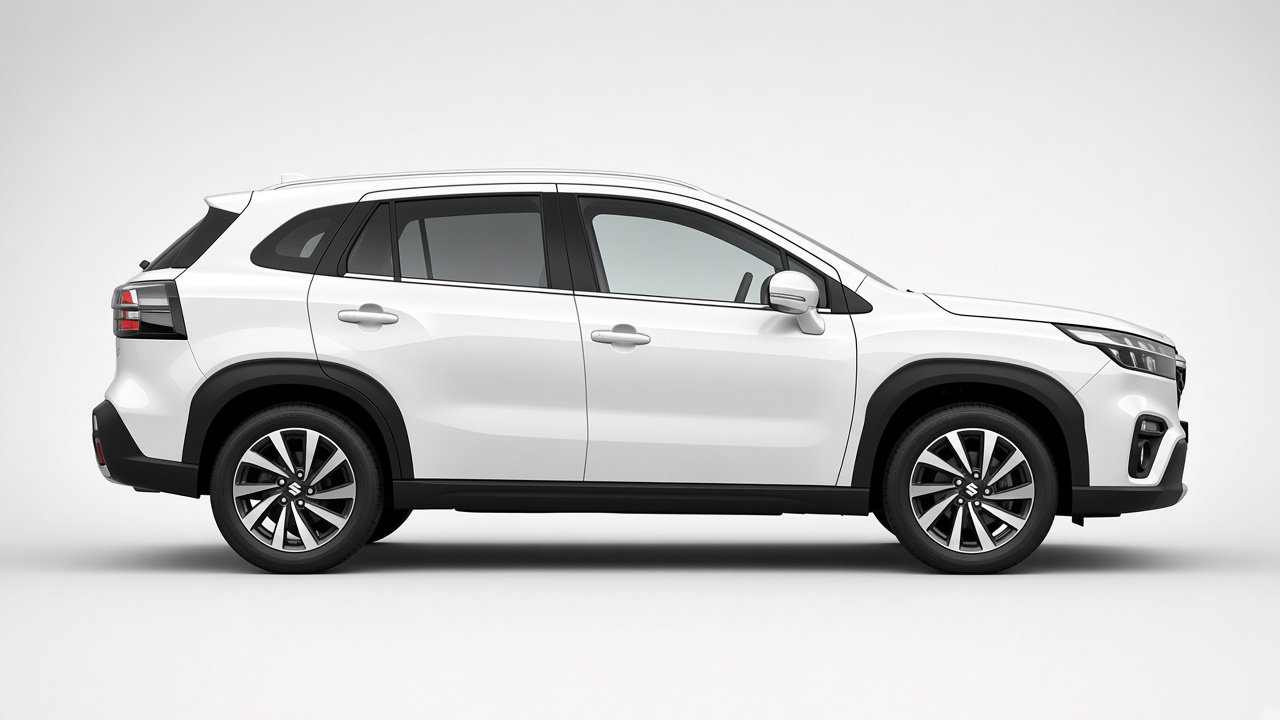
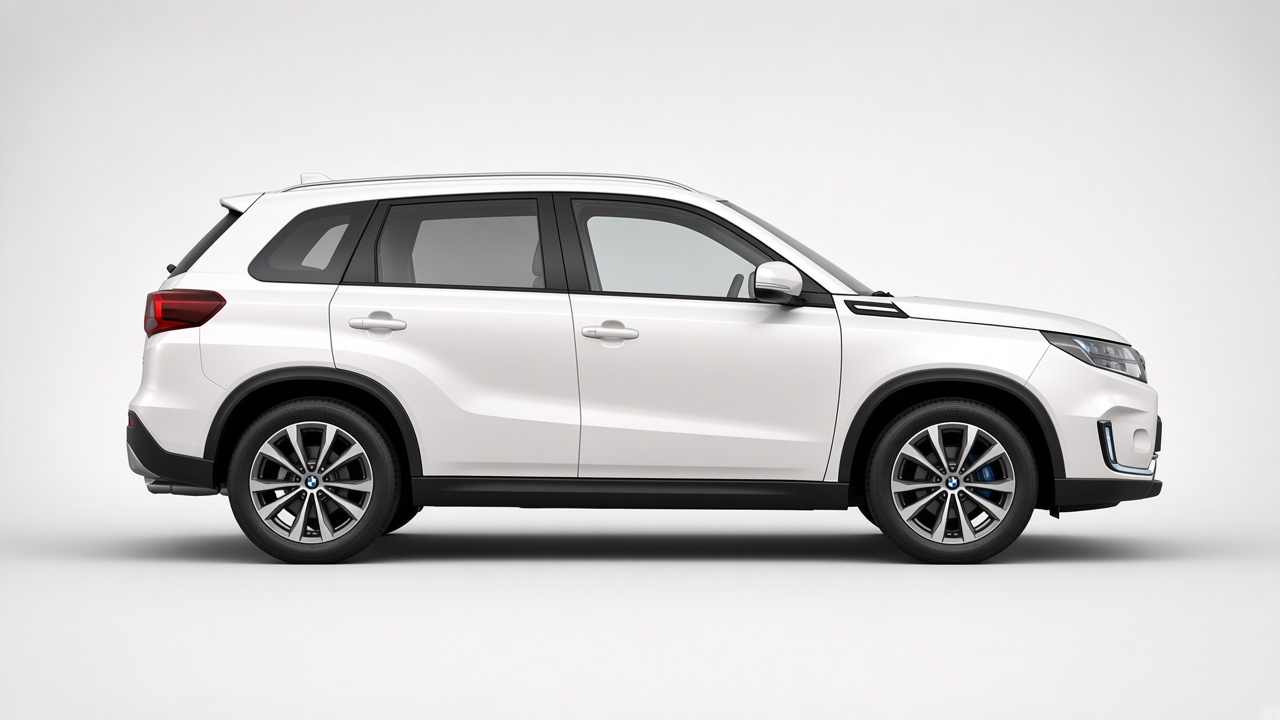
The Vitara nameplate has been around since the 1980s, and throughout its generations, it has always kept some familiar exterior touches, particularly around the front fascia.
However, this EV is actually an entirely separate model that bears no physical resemblance; it’s just trading off the badge.
Under the skin, the petrol and hybrid Vitara are built on a separate platform from the eVitara, too.
Don’t get me wrong, I quite like the new edginess this electrified Vitara brings, but it could really be anything; it doesn’t feel like a Suzuki.
I also think that unless you have it in a dark shade like the green this test car wore, the high levels of plastic cladding on the wheel arches, front bumper, and side trim would probably be a bit much.
The green is really attractive in my opinion, but Suzuki wants more than $1300 for it, which is really premium car maker pricing.
What is the Suzuki eVitara like inside?
Like the exterior, the inside of the Suzuki eVitara is entirely different to its namesake.
On the plus side, it feels much more modern, swapping a tiny infotainment screen and a traditional-style cluster, surrounded by far too much piano-black plastic, for one long panel that combines both displays.
Suzuki hasn’t entirely done away with all the shiny plastic, though; there’s still plenty of it on the centre console and on the doors, juxtaposed by dark brown trim.
And despite the hefty price tag, there are quite a lot of other harsh plastics to be found, and a very scratchy headliner.
Rectangular vents replace circular ones, but they aren’t any more attractive. Now they’re just surrounded by silver plastic that’s possibly meant to look like chrome but doesn’t.
The cabin still has a satisfying number of buttons and physical dials for the volume and some climate functions, but others are on the infotainment screen, such as the heated seats.
The biggest frustration is that in trying to make the interior more interesting and stylish than before, Suzuki has overlooked one of the Vitara’s greatest strengths – practicality.
Despite being a small SUV, what the hybrid Vitara does well, as the previous-generation petrol did too, is maximise space.
The EV has none of that. The central cupholders are average-sized, but the front doors can barely accommodate a slim bottle, and the rear doors can’t fit anything other than one of those tiny water bottles they give you on aeroplanes.
There’s a small storage space underneath the centre console, but it’s awkward to access and can’t hold much other than wallets and the odd snack.
The storage bin under the armrest isn’t generous either.
In the second row, as before, there is one pocket on the back of the front passenger’s seat for storage, but it gains an armrest with two cupholders when the middle seat is folded down.
You can fit two child restraints comfortably in the outboard seats, which have ISOFIX anchors, and you can use each of the three positions since there are top-tether points for all of them.
Realistically, though, an adult cannot fit in the middle with two child seats in play, and even a child old enough not to use a restraint probably wouldn’t be that comfortable.
Leg and head room in the back row are pretty much on par, despite the EV having a longer wheelbase.
But undoubtedly the greatest disappointment, especially for families, is the boot, which has shrunk enormously.
The Vitara’s boot can be lowered to open up more space, but the eVitara’s can’t because the floor is occupied by the tyre repair kit and there’s only enough room for a charging cable.
My daughter’s pram just about fits, but nothing else will, so it’s a choice between having that and having space to put the weekly grocery shop.
On top of that, it goes without a powered tailgate, even in the top-of-the-line variant, and it retains the cheap cardboard parcel shelf.
| 2026 Suzuki eVitara Ultra AWD | |
| Seats | Five |
| Boot volume | 238L seats up 562L seats folded |
| Length | 4275mm |
| Width | 1800mm |
| Height | 1635mm |
| Wheelbase | 2700mm |
Does the Suzuki eVitara have good infotainment?
The technology in the electric Vitara is fresher and more modern than in the petrol model, but it still falls behind leaders such as Tesla and even many new challenger brands.
The big screen looks flash, but it’s actually not capable of all that much.
The ‘apps’ icon just takes you to the main screen, which is split between the virtual climate controls and a picture of the car with shortcuts to Apple CarPlay or Android Auto.
Beyond that, you’ve really only got multimedia for music or podcasts, the ability to make phone calls, settings, or basic information about energy consumption and range.
The display itself is clear enough, but it’s ridiculously slow to respond to inputs. Even turning up the volume dial doesn’t react for a good few seconds.
It’s also incredibly frustrating that features like the heated seats are only on-screen, and it takes four clicks to turn them on. Similarly, there is a physical button to turn regenerative braking on or off, but selecting how much you want requires delving deep into submenus.
For connectivity, you now have access to wireless Apple CarPlay and Android Auto, because previously the wired connection through the single front USB-A port was unstable at best.
Both rows now benefit from one Type-A and one Type-C.
Even though the sound system has been upgraded from the Motion, it’s still not very good.
For owners, Suzuki offers its connected services through the Suzuki Connect app, covering basic features such as remote locking, location services and vehicle alerts. It is free for the first three years, after which there is a fee to continue to use some services.
What is the Suzuki eVitara like to drive?
The Suzuki eVitara Ultra AWD is powered by two electric motors, one on each axle, producing a combined 135kW/307Nm. Power is sent to all four wheels through a single-speed automatic transmission.
Whereas the Vitara has always been quite an easy and comfortable little car to drive, electrification has made it even better.
Those numbers are well up on the 86kW/156Nm my naturally aspirated Vitara is capable of, and the real-world results are tangible.
Whereas the petrol can take its time to get going, and protest from the effort it takes, like other EVs, the Suzuki eVitara doesn’t bat an eyelid.
It’s quick off the line, even in Eco and nippy and light on its feet at higher speeds, too.
Like its predecessor, however, the steering is very light. The EV benefits from having a touch more weight to it.
The ride is also more comfortable. It’s very soft and absorbs virtually all impacts well, though if the camber changes you might notice it bouncing for a few seconds as it tries to sort itself out.
The impact of hitting potholes or travelling over speed bumps is significantly less harsh, though.
There’s still some roll in the body when entering tight bends, but it’s not dreadful, and the grip from the MRF Wanderer Ecotred tyres is actually not as bad as I’d anticipated.
I wasn’t pushing the eVitara especially hard, though, or driving in the wet, which could make a difference.
Overall it’s still quite loud, with wind and road noise invading the cabin, and the sound of the engine has just been replaced by a noticeable electronic whistle.
| Key details | 2026 Suzuki eVitara Ultra AWD |
| Engine | Dual electric motors |
| Power | 135kW |
| Torque | 307Nm |
| Drive type | All-wheel drive |
| Transmission | Single-speed automatic |
| Power-to-weight ratio | 72.6kW/t |
| Weight | 1860kg (kerb) |
| Spare tyre type | Tyre repair kit |
| Tow rating | 750kg braked |
| Turning circle | 10.4m |
What are the Suzuki eVitara’s best deals?
You can find examples of the Suzuki eVitara for sale on Drive Marketplace, alongside other new and used Suzuki models.
Find your nearest Suzuki dealer here to see the eVitara in the metal and take one for a test drive.
For more details relating to pricing, specifications, and the latest offers on the eVitara, click here.
Should I buy the Suzuki eVitara?
The Suzuki eVitara is in almost every respect well and truly outgunned by its competitors.
The driving range is fine but not good, and the charging is slow, which lets it down further.
The things it does well, others do well too; it’s comfortable and easy to drive – there’s just nothing it does that’s exceptional to help it stand out at that price.
You could argue the previous petrol Vitara wasn’t a stand-out either, and you’d be right. As an owner, I bought it because it was cheap; it never pretended to be something it wasn’t.
Not only is the eVitara not better, but it is also more compromised in terms of space, and the tech hasn’t leapt forward as much as it needs to.
Even with all-wheel drive, $60k is too much to ask for this car.
The post 2026 Suzuki eVitara Ultra review appeared first on Drive.