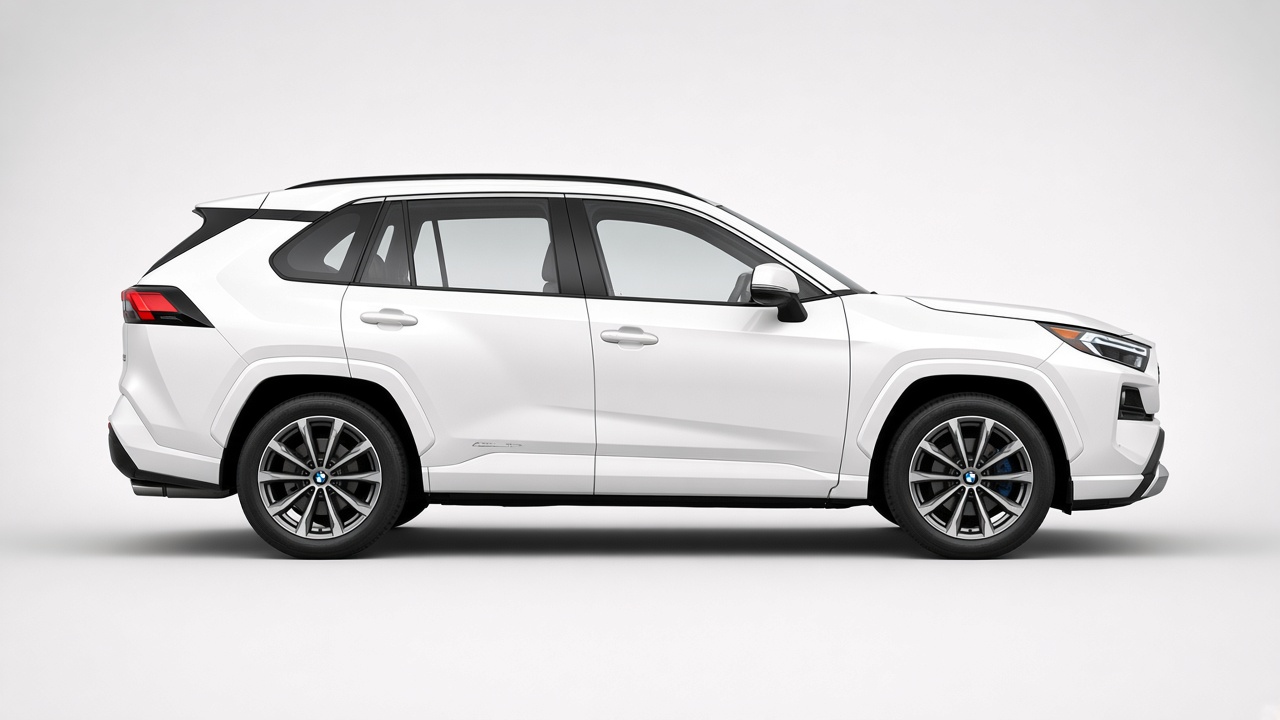
2026 Toyota RAV4 XSE PHEV
Once upon a time, Toyota was at the forefront of car tech, and the brand certainly doesn’t want you to forget that. Mass-producing the first-ever hybrid car is certainly a feat, with the Prius holding the title of most-efficient car in the world for many years.
That car resembled tech straight out of Akira when it launched, and the brand rode that wave for nearly three decades as the development really put Aichi Prefecture on the map. Over one billion dollars was spent back in 1997 to develop the tech in a tremendous leap of faith.
Then the brand simply didn’t take a risk like that again. Some glimpses of things to come, like the hydrogen Mirai, showed up, but Toyota continued to play it safe through the electric revolution.
The Chinese ran away with the affordable plug-in hybrid phase while Toyota stepped away from being at the forefront of tech, rather taking a conservative approach to ensuring it’s the direction buying trends go and it’s the tech people want.
The plug-in hybrid of the brand’s most popular passenger vehicle finally landed Down Under in mid-2026, but the field in Australia is now stacked full of more affordable Chinese brands with a whole lot more showroom appeal than the new RAV4, which is still built on the 2019 chassis.
So is the Toyota RAV4 the plug-in hybrid you want? Or is it too late to the market, swallowed by choice? I jumped in the second-highest specification to find out if it’s worth the Toyota tax.


How much is a plug-in hybrid Toyota RAV4?
The XSE trim of the RAV4 plug-in hybrid starts at $59,515 plus on-road costs for the front-wheel drive variant we are in, or you can opt for an all-wheel drive for $64,015 plus on-road costs. Making it the second-most pricey option in the range, below the GR Sport from $66,340 plus on-road costs.
To get technical, the car we are in is the most affordable entry into a plug-in hybrid Toyota, seeing a price increase over the non-plug-in hybrid XSE AWD from $58,340 plus on-roads – which is not available in a front-wheel drive. Though a cheaper GXL PHEV is set to arrive next year for closer to $50,000 plus on-roads.
You need to opt for this trim if you want things like heated and ventilated front seats, a 360-degree camera, leather-like and suede upholstery, power adjustment on the passenger seat, a sunroof, and a few other aesthetic additions like illuminated entry, gloss black trims, and metallic interior trims.
Brought up from lower specifications is the 12.9-inch infotainment screen, power adjustment for the driver’s seat, wireless phone charger, and a full suite of safety assists.
All variants, plug-in hybrid or just regular hybrid, share the same 2.5-litre four-cylinder petrol engine. Still, the additional $5675 removes the closed-loop hybrid system and replaces it with a 22.7kWh plug-in system, which Toyota claims will be good for up to 121km of electric-only driving.
Had Toyota launched this car three years ago, there would’ve been just one competitor in the affordable medium-SUV PHEV segment, the Mitsubishi Outlander, and it also would’ve capitalised on massive fleet benefits through the fringe benefits tax exemptions.
But in 2026, the competition is stark, with Chinese models well and truly undercutting prices, with some pretty intense showroom appeal: the Geely Starray from $37,490 plus on-road costs, the Haval H6 PHEV from $44,990 drive-away, and even the Jaecoo J7 PHEV from $39,990 drive-away.
While the neighbours over the East China Sea are nearly halving the cost of a medium-sized SUV PHEV, the truth is that nothing under $60,000 is exceptionally good – they’re all just kind of okay, which gives the Toyota RAV4 a chance to excel and show its worth.


Is the Toyota RAV4 XSE nice inside?
The chances of you reading this thinking of upgrading from your previous generation RAV4 are quite high, considering it’s been Australia’s most popular passenger vehicle for many years. If you fit that profile, the 2026 model will feel vaguely familiar, with the same amount of internal space as anything 2019 or newer.
A very non-Toyota move was to remove some of the physical buttons and put them through the new 12.9-inch infotainment screen. You still have physical temperature control buttons, but if you want to adjust the fan speed or make other changes, then you are forced to use the touchscreen controls.
Not having physical buttons is a particular sore spot for such a utilitarian car like the RAV4; it’s a tough one to get used to adjusting on the fly and certainly isn’t the most user-friendly system by far. Especially when you look down to see the traction-control button being the centrepiece of the physical buttons, you are absolutely not alone if you never touch that button during the ownership of this car.
Still, the new screen is certainly a jump in quality over the older vehicle; infotainment systems do not need to be any larger than this, and certainly don’t let your wandering eye lead you astray with new competitors offering flat-screen TV-sized infotainment.
The rest of the interior borders on spartan, though you could look at it from a no-frills perspective. I must admit that I expected a bit more thoughtfulness in the interior design from a $60,000 car, but it is certainly very Toyota.
The seats do their job of being comfortable enough on longer trips without having that signature sticky fake leather feel to them, though having ventilated seats will change your life if you’re on the fence between this specification and waiting for the GXL version to land.
The second row also has more than enough space for two full-sized adults to fit comfortably; three kids would likely have no issue living back here in day-to-day journeys with the odd road trip thrown in. They’ve got two USB-C ports and twin vents for some additional comfort.
Having the breathable material for the middles of each seat adds a lot more to comfort than most would realise, though particularly messy families might have to set aside some additional cleaning time over a flat faux leather trim.
Toyota still hasn’t supplied a boot-size figure, though it looks around the same size as the previous model, which was 580 litres with the seats up. All models are fitted with an actual spare wheel instead of some silly tyre repair kit found in most new cars.


How does the Toyota RAV4 PHEV drive?
One thing I feel a lot of customers in the mid-size SUV segment are now overlooking is the way the car drives. From a safety perspective, having a car that handles well and is predictable does more to keep you safe than some obnoxious driver monitoring camera or poorly optimised lane keep.
Historic RAV4 customers have always been treated to a well-handling and predictable car, and the new model is certainly no different. You are met with a slightly firmer ride than some of the sloppier offerings on the market at the moment. Still, it’s not uncomfortable by any means, just a bit of a compromise to make the extra weight from the PHEV system hold its composure through turns and over bumps.
The electric motor puts out 151kW by itself, which is more than enough for darting around town. At the same time, combined power with the petrol engine pushes it up to 201kW – a good push up over the old model but transfers more into a lazier, less hard-working petrol engine rather than noticeable speed.
The downside to having the car rely more on electric power compared to its closed-loop hybrid brothers is the fact that engine noise becomes more noticeable when the petrol power fires up – it could be perceived as noisy. Still, it’s no louder than any other naturally aspirated medium SUVs on the market.
Crunching the numbers, you should realistically be able to get 0L/100km on a day-to-day basis if you’re living less than an 80km to 100km round trip from work. If you’re less liberal with the charging, I managed 4L/100km in hybrid mode with charge in the battery. Though once depleted, the car acted as a regular hybrid and saw around 5.8L/100km.
Unfortunately, in this new age of cars, we have given more and more control to the computers, and they’re still certainly having some teething issues. The driver monitoring camera is very eager to tell you you’re not looking at the road with a beep, when you most certainly are. You can’t turn it off unless you are at a complete stop; even then, you need to turn it off every time you start the car.
The lane centring with cruise control set also needs some work, which Toyota should have the ability to update in the future, as it will snatch the steering wheel when it thinks you’re getting too close to the road markings when you are in fact not.
Less of an issue but still quite jarring is how nervous the forward collision warning is, often chiming in to tell you you’re about to have an accident when there is simply a car parked to the side on a narrow street.
Most of these options to turn off the more annoying safety aids are well buried in the menus, though an owner would likely have no issue learning to find them quickly.


| Key details | 2026 Toyota RAV4 XSE PHEV 2WD |
| Engine | 2.5-litre four-cylinder petrol plug-in hybrid Single electric motor |
| Battery pack | 22.7kWh |
| Driving range | 121km (WLTP) |
| Power | 201kW |
| Torque | 272Nm |
| Drive type | Front-wheel drive |
| Transmission | Continuously variable automatic |
| Length | 4600mm |
| Width | 1855mm |
| Height | 1680mm |
| Wheelbase | 2690mm |
Is the Toyota RAV4 PHEV worth the money?
The headlines you see of ‘new brand set to land in Australia with a medium-SUV for chump-change’ can certainly lure you in, especially when you see that white pleather over everything and the single giant screen.
But there is a case to be made for the RAV4: you’ve got an SUV from a brand that’s not going anywhere, with capped-price servicing at $325 every 12 months and a car that simply drives like a car.
I couldn’t live with the ADAS in its current state, but there is hope Toyota will adjust it to be better suited to people who have ears.
It is a little bit too pricey given the current climate, and it’s way off from being the best-kitted and trimmed medium SUV in this price range, but there’s something friendly about driving it that a lot of these other brands don’t have – and that’s where Toyota will win people over.


The post 2026 Toyota RAV4 XSE PHEV review: A little too late to the plug-in party appeared first on Drive.