Unremarkable in the best way
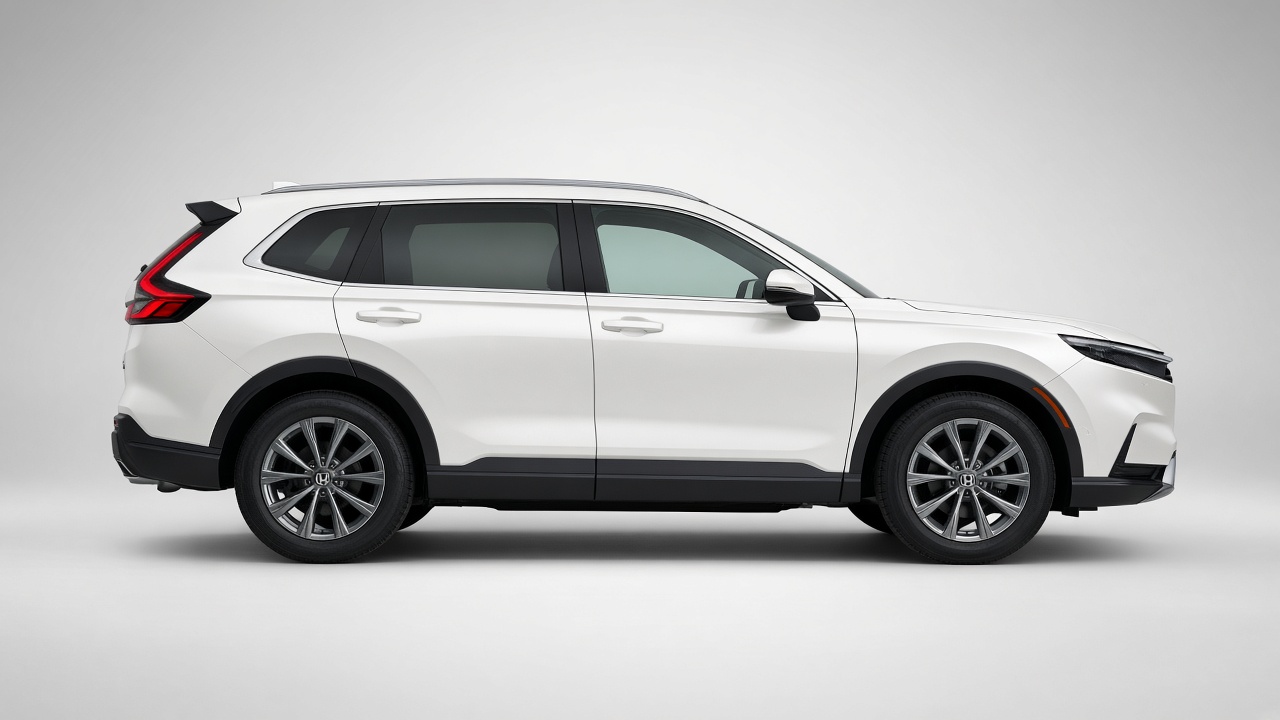
If you wanted a visual representation of the phrase ‘middle of the road’, the Honda CR-V e:HEV X might be it. And that’s not necessarily a bad thing.
There are six variants of the CR-V medium SUV, and the e:HEV X hybrid sits towards the entry level as the most affordable hybrid CR-V variant, priced at a clean $49,900 drive-away.
For that, you’ll get five fabric-covered seats, a 2.0-litre, four-cylinder petrol engine with a hybrid system and front-wheel drive, and equipment like dual-zone climate control, front and rear parking sensors, and a hands-free power tailgate.
The CR-V e:HEV X is by no means the cheapest medium hybrid SUV on the market (models like the GWM Haval H6 and Hyundai Tucson have it beat), but it’s also not the most expensive either (the new Toyota RAV4 Hybrid starts from just above $50,000 drive-away).
Plus, the Honda can lay claim to impressively low servicing costs, frugal fuel consumption and a highly functional cabin.
None of these things will change your life on their own, but together they amount to a car that can materially improve your day-to-day existence.
And that’s what a week with the Honda CR-V e:HEV X taught me: Sometimes, unremarkable can be exactly what you need.


Finally, some buttons!
Getting into the CR-V after a series of brand-new and high-tech electric vehicles, I breathed a sigh of relief.
First of all, it was refreshing to see buttons for key features like climate control and audio volume. The CR-V’s interior is basic in the best way – you know where things are located, it’s easy to interact with on the go, and there are spots for all the things you need to store (a total of eight cupholders and I’m pretty sure my family used every last one).
I will say the 9.0-inch touchscreen at the centre of the dash feels surprisingly small and dated by modern standards, but the simplistic design and well-sized icons mean it is incredibly functional.
There’s wireless Apple CarPlay, but Android users will have to make do with a wired connection. In my experience, the wireless CarPlay works 90 per cent of the time, but on a handful of occasions the audio from my phone simply wouldn’t play, and I had to disconnect and reconnect to resolve the issue.
Otherwise, you’ll get access to the second generation of the Honda Connect interface, which brings the CR-V in line with its high-tech peers by offering digital key capability, built-in Google functionality (which includes a Google voice assistant and the very handy Google Maps as your satellite navigation system), and car location tracking.
Current-generation CR-V buyers will get three years of Honda Connect for free, and after that – well, Honda says it is still determining pricing. Come back in 2029 to find out more.


Easy to drive and impressively economical
On the road, the CR-V is well-mannered and unexpectedly punchy. It’s incredibly easy to drive and a true “get in and go” car at a time when it feels like plenty of vehicles require a one-hour induction session just to put them into gear.
The only learning curve you’ll be faced with is the needlessly convoluted gear shifter, which involves both buttons (park, neutral, drive) and a pull-up switch (reverse), which is designed to avoid accidental selection but isn’t all that easy to operate, particularly during quick manoeuvring.
You’ll occasionally notice the handover between electric and petrol power when the engine grumbles at lower speeds, but it’s mostly imperceptible. A quickfire freeway merge from a standstill was handled without complaints – and even offered a bit of excitement. There’s a Sport mode too that adds some weight to the steering and a sharpness to the acceleration.
Visibility is a strong suit thanks to big chunky mirrors and large windows all round, and it’s aided by attentive front and rear sensors and a simple reverse camera that does the job without showing off. The side mirrors automatically tilt to the perfect angle when you’re parking, so you don’t miss any surprise kerbs.
The ride is mostly smooth, but the CR-V isn’t as adept at handling bigger bumps as some of its rivals. Awkwardly shaped speed bumps can throw the car off balance and result in some edge in the cabin, but it’s nowhere close to being a dealbreaker.
Honda says the CR-V can average fuel consumption of 5.5L/100km and I landed one decimal point away from that promise at 5.6L/100km across a week of driving on suburban roads and freeways. I reckon that’s impressively low for an SUV with a sizeable footprint.


The safety conundrum
On the safety front, the CR-V e:HEV X gets essentials like blind-spot monitoring, autonomous emergency braking and lane departure warning as standard, and they work harmoniously to assist rather than overwhelm.
Some prospective buyers might be spooked by the fact the CR-V received a four-star safety rating from ANCAP back in 2024, which has carried over to the updated model.
A lot of this has to do with the fact that Australian-delivered CR-V models miss out on the more comprehensive version of the Honda Sensing safety suite, known as Honda Sensing 360, that is offered in other markets.
This system provides 360-degree coverage by adding additional radars at the front and corners of the car, allowing for more advanced safety capabilities.
As a result, it enables capabilities like a front cross-traffic warning, lane change collision mitigation and active lane change assist – none of which are available on local CR-V models. It also expands the capabilities of adaptive cruise control and the collision mitigation braking system.
Asked whether Aussie CR-V models are likely to gain Honda Sensing 360 anytime soon, Honda Australia offered the following statement:
“Honda takes vehicle safety very seriously, with safety being a core pillar of Honda’s philosophy. The Honda vehicles we have in the market today are the safest in Honda’s history of manufacturing. We are confident that our overall safety packaging within our current lineup of vehicles is more than equipped to reduce the impact or mitigate an accident involving an object or other road users.”
Sure, but given so many of its rivals – particularly electric models – offer things like full self-driving capabilities and crisp 360-degree cameras as standard, the CR-V could afford to upgrade.
Comfy cabin, but no spare wheel
In e:HEV X form, the CR-V’s interior is not particularly fancy, but it is spacious, comfy and practical, which, as a parent, I’d take any day of the week. The touchpoints are nice enough (the steering wheel is leather-wrapped), and the storage options are endless.
The CR-V has an impressively flat floor in the back seat for a car with a transmission tunnel, and rear seat occupants score so much toe room you’ll likely lose several large items under the front seats as I did.
Boot space is also excellent, but the downside of the hybrid CR-V variants is that you don’t get the full-size spare wheel offered on the entry-level petrol variant and instead have to make do with a tyre repair kit.
This kind of thing gives me the heebie-jeebies as someone who has had multiple flat tyres in the last four years and experienced the benefits of a full-size spare firsthand.


| Key details | 2026 Honda CR-V e:HEV X |
| Engine | 2.0-litre four-cylinder petrol hybrid |
| Power | 109kW |
| Torque | 182Nm |
| Drive type | Front-wheel drive |
| Transmission | E-CVT hybrid transmission |
| Length | 4704mm |
| Width | 1866mm |
| Height | 1681mm |
| Wheelbase | 2701mm |
My all-time favourite feature…
One of my favourite features on the CR-V was the walk-away automatic door locking offered on all grades, which unlocks the car when you walk up to it, and locks it when you walk away, without requiring you to interact with the key.
This functionality is offered on plenty of other cars, but in my experience it never works quite as seamlessly as Honda’s system. It meant I never had to fumble around in my handbag looking for keys while juggling a toddler and several bags. It’s the little things like this that genuinely improve your daily life.
Speaking of improvements to one’s daily life, you’d have to count Honda’s low service costs as one of these little perks. They used to be lower, but sadly, like everything else, prices rose on October 1, 2026, by a whopping 40 per cent, raising it from $199 to $279 per service visit. That’s still pretty manageable.
The most affordable hybrid variant of the Honda CR-V is comfortable, well-priced, efficient and convenient. Add a spare wheel and some extra safety features, and it would be almost perfect.


The post 2026 Honda CR-V e:HEV X review: The car I’ve been craving appeared first on Drive.